"Cialis" and "tadalafil" get used almost interchangeably in conversation, which makes the actual relationship between them confusing. One is a brand. One is a chemical. Here's what genuinely separates them — and what doesn't.
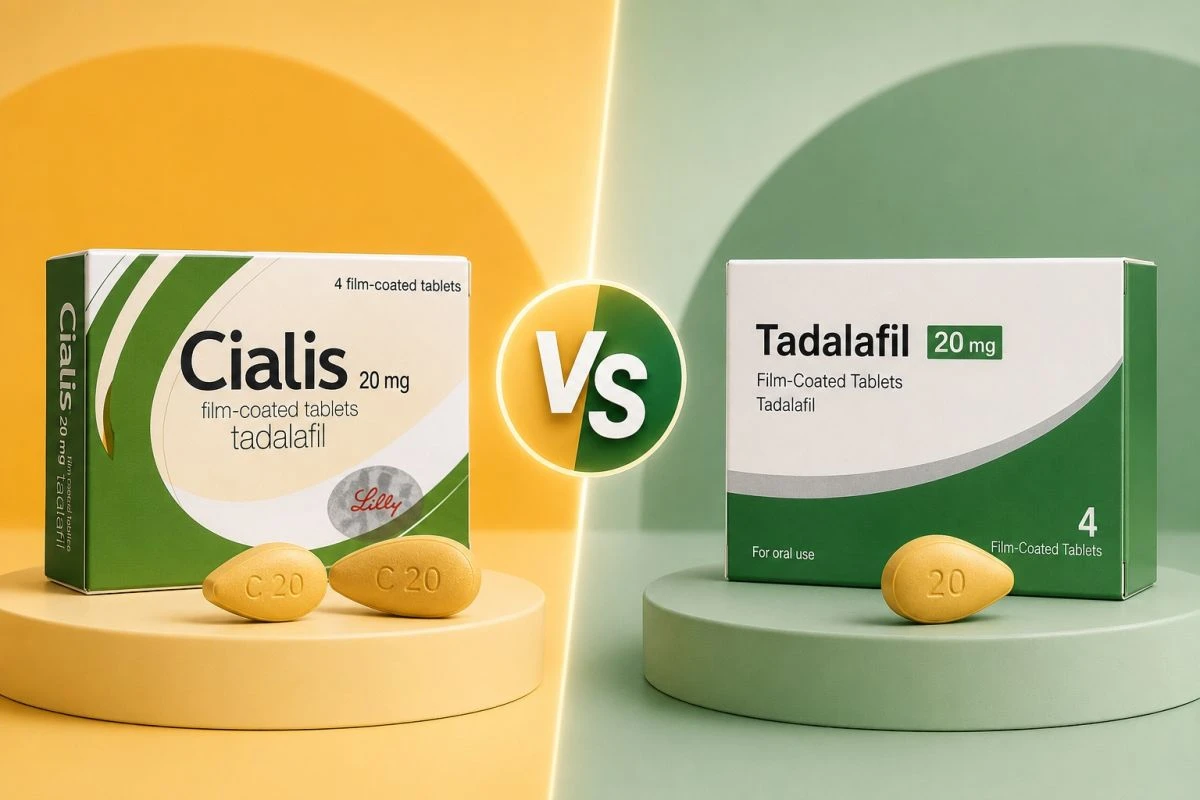
Cialis is a brand name. Tadalafil is the active drug inside it. When people ask "which one is better," they're often really asking "is the brand-name version worth the extra cost compared to the generic," because chemically, Cialis and generic tadalafil tablets are meant to be the same compound at the same strength. The real differences live in manufacturing source, price, appearance, and a handful of practical details — not in how the drug works inside the body.
That said, "meant to be the same" and "always identical in practice" aren't quite the same claim, and it's worth understanding where the nuance actually sits.
Tadalafil is a PDE5 inhibitor — a class of medication that also includes sildenafil (Viagra) and vardenafil (Levitra). It works by blocking phosphodiesterase type 5, an enzyme that breaks down cyclic GMP in smooth muscle tissue. With that enzyme inhibited, blood vessels in the penis relax more readily in response to sexual stimulation, allowing increased blood flow that supports an erection.
Tadalafil is approved to treat:
It was developed by ICOS Corporation and later brought to market by Eli Lilly, which owns the Cialis brand.
Since Cialis often gets compared to Viagra as much as to generic tadalafil, it's worth a quick note on why tadalafil carved out its own niche in the first place: duration. Sildenafil's effects generally last around 4-6 hours. Tadalafil's half-life is dramatically longer, giving it an effective window that can last up to 36 hours in some users — which is where its "weekend pill" nickname came from. This longer window is also what makes a low-dose daily regimen possible with tadalafil, something not really practical with shorter-acting PDE5 inhibitors.
Cialis is Eli Lilly's trademarked brand name for its tadalafil product. When Eli Lilly first brought tadalafil to market in the early 2000s, it held exclusive rights to manufacture and sell it under patent protection. During that patent period, Cialis was the only legal tadalafil product available in most regulated markets — there was no generic alternative, so "Cialis" and "tadalafil" were functionally synonymous for consumers.
That changed once Cialis's patents expired. In the United States, generic tadalafil became available in 2018. In the UK and EU, generics arrived even earlier, following the expiration of European patent protections around 2017. Once patents lapse, other pharmaceutical manufacturers are legally permitted to produce and sell the same active compound, provided they meet the regulatory approval standards of the country they're selling in — which is a meaningfully different situation from something like Kamagra, which sidesteps those approval standards entirely rather than going through them.
This is the most consistent, most significant difference. Brand-name Cialis typically costs substantially more per tablet than generic tadalafil, sometimes several times more, because the price of a branded drug reflects patent-era R&D recovery, marketing, and brand premium — costs a generic manufacturer doesn't carry in the same way.
Cialis is manufactured exclusively by Eli Lilly, with consistent tablet shape, color (its distinctive yellow, almond-shaped tablet), and packaging. Generic tadalafil, on the other hand, can be produced by multiple approved manufacturers, meaning the tablet's appearance, shape, color, and inactive ingredients (fillers, coatings, dyes) can vary between generic brands, even though the active ingredient and dose are equivalent.
While the active compound and dosage strength must match for a generic to gain regulatory approval, the inactive ingredients — binders, coatings, dyes — aren't required to be identical. For the vast majority of people this makes no practical difference, but in rare cases, someone with a sensitivity to a specific filler or dye might notice a difference between a particular generic formulation and the brand-name version.
Generic tadalafil approved by agencies like the FDA or MHRA must demonstrate bioequivalence to the branded product — meaning it delivers the active drug into the bloodstream at a comparable rate and extent. This isn't a loose approximation; it's a specific, tested regulatory standard. Once a generic clears that bar, it's considered therapeutically equivalent, not just chemically similar.
Cialis is available in ED-specific doses of 2.5mg, 5mg, 10mg, and 20mg, including a low-dose daily-use option. Generic tadalafil is generally available in the same dosage strengths, though availability of every specific strength can vary somewhat by manufacturer and market.
A lot of the "Cialis vs tadalafil" confusion online isn't really about the drug at all — it's about counterfeit and unregulated products trading on the name recognition of both terms. Because tadalafil is a globally known, high-demand medication, it's also a frequent target for counterfeiters, similar to what happens with sildenafil-based products. Unregulated websites sometimes market "generic Cialis" or "tadalafil" products that haven't gone through any approval process at all, blurring the line between legitimate generic tadalafil (approved, regulated, bioequivalent) and unregulated tadalafil-labeled products (unverified content, unknown quality control).
This is the actual distinction worth paying attention to — not "brand vs. generic" in the abstract, but "regulated vs. unregulated" in practice:
Not meaningfully. Whether a doctor prescribes Cialis by brand name or writes a prescription simply for "tadalafil," the clinical evaluation beforehand is the same. A prescriber will typically consider:
Pharmacies will often dispense the generic by default in many countries unless a prescription specifically indicates "brand medically necessary" or the patient requests the brand name, largely because of the cost difference and equivalent clinical effect.
No — side effects are attributable to the tadalafil molecule itself, not to whether it's sold as Cialis or as a generic. Commonly reported effects include headache, back pain, muscle aches, flushing, and nasal congestion. Rarer but more serious risks include sudden vision or hearing changes and priapism (a prolonged, painful erection requiring emergency care). Because these risks come from the drug itself, they apply identically regardless of which manufacturer's version of tadalafil someone takes — brand or approved generic.
For most people, once tadalafil is prescribed by a doctor and dispensed through a licensed pharmacy, the practical choice between brand-name Cialis and an approved generic comes down to cost and personal preference rather than effectiveness. Some patients simply prefer sticking with the branded product they're familiar with; others switch to generics without noticing any difference beyond the amount charged.
The more consequential choice isn't "Cialis or tadalafil" — it's "regulated or unregulated." A prescription from a licensed provider, filled at a licensed pharmacy, ensures the tablet's contents match its label, regardless of whether that label says Cialis or a generic manufacturer's name. Skipping that regulated pathway — buying tadalafil-labeled products from unverified online sellers — reintroduces the same risks seen with other unregulated ED medications: inconsistent dosing, unknown fillers, and no accountability if something goes wrong.
Cialis and tadalafil aren't competing products — Cialis is simply the original brand name for the tadalafil molecule, and once its patents expired, other manufacturers gained the legal right to produce the same active ingredient under its generic name. Chemically and clinically, an approved generic tadalafil tablet is designed to function the same way as brand-name Cialis, at a fraction of the price. The meaningful distinction to focus on isn't brand versus generic, but whether the specific product — whatever it's labeled — has actually gone through regulatory approval and reached you via a licensed pharmacy.
This article is for general informational purposes only and isn't a substitute for professional medical advice. Anyone considering ED or BPH treatment should consult a licensed healthcare provider before starting any medication.

Best Shipping Service
Always Guaranteed
Checkout System